Global mean sea level (GMSL), that has risen steadily over the last century, is expected to rise by the end of this century and will continue to rise beyond 2100 if the current trend in global average temperature is not reversed. Because of the inertia of the climate and the equilibrium-response time scale of ice sheets that is much longer than those of the atmosphere or ocean, it is difficult to assess the extent of sea-level rise for different levels of global average temperature increase relative to pre-industrial levels. Past sea-level records provide invaluable information about the response of ice sheets to climate forcing and to better anticipate future long-term polar ice-sheet response as well as their nonlinear behavior to global warming by studying key periods from the geological record that experienced rapid increase in temperature or warmer periods than the pre-industrial period.
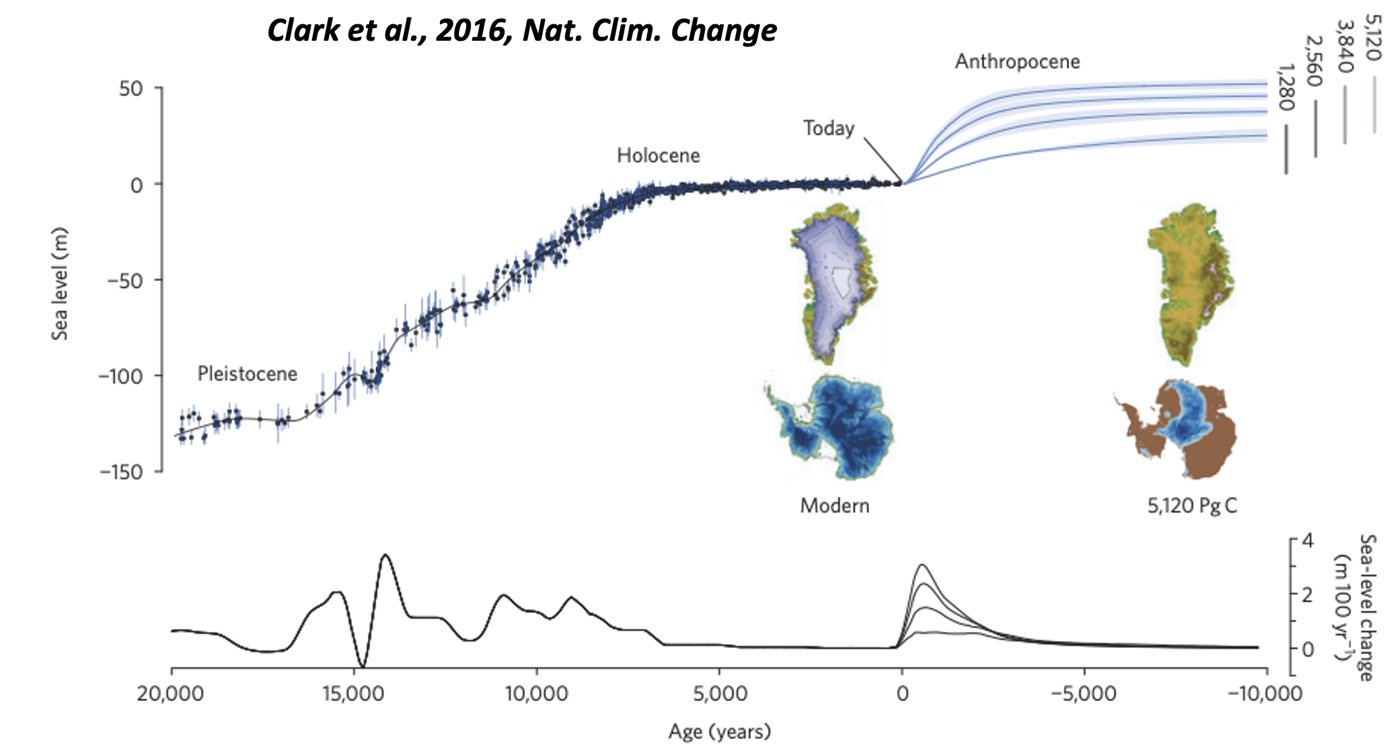
After reviewing the main drivers of past sea-level variations, this course will explore the various archives and geochemical methods used to reconstruct and date them. More specifically: - The use of continuous stable isotope records from marine sediment cores, that is driven at first order by changes in continental ice volume - The use of coral reef and their dating by the U-Th method to determine sea-level rise during deglaciation and warm interglacial periods